Capsule
Onboarding Improvements with User Interviews and Usability Testing
User Interviews I Customer Onboarding I Order Conversion
Led research that uncovered major friction in the onboarding flow, resulting in improved conversions and a strategic shift in how leadership approached account creation
The Problem
Connor is watching Hulu when a Capsule ad appears. With a doctor’s visit on the horizon and past pharmacy hassles in mind, he decides to try Capsule.
But when he visits the website, he hits a wall, he can’t create an account without an existing prescription. He wants to be ready ahead of time, but Capsule won’t let him sign up until your doctor sends one in.
This is the experience many users encountered when trying to sign up for Capsule. The acquisition Product Manager learned about this from an in-app survey on the first step of the sign in page.
With acquisition as a core business priority and the sign in experience a key lever the product team needed to explore. Yet, the Product Manager faced pushback from leadership who felt that there wasn’t a strong enough reason to support those without prescriptions.
I was brought in by the Product Manager to lead end-to-end generative research to understand why these two key user groups were trying to sign up without prescriptions. The goal was to determine whether creating a dedicated flow for them could improve downstream acquisition (i.e., filled prescriptions). Despite strong opinions from leadership, the data-driven product team was open to research that could demonstrate these users’ value to the business.
This research had two main components:
Generative Discovery
(N = 19)
Moderated sessions with two user cohorts (no prescription vs. existing prescriptions) to uncover motivations like vetting and pricing clarity.
Usability Testing
(N= 5)
Inputs from A/B test failures to iterate and refine the onboarding flow.
Generative Discovery
Problem
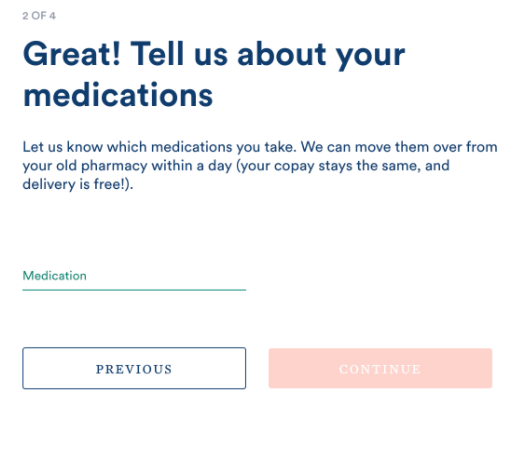
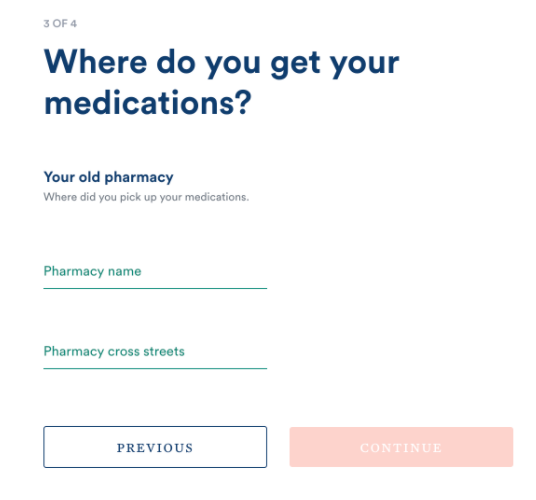
Capsule’s old onboarding process was built for customers to transfer existing prescriptions at other pharmacies into Capsule. The onboarding process was a step-wise form that could only be filled out if a customer had existing prescriptions to be filled.
A previous survey to this work had uncovered that there were customers who were looking to “get started” at Capsule did not have any medications to send from another pharmacy, and instead either didn’t yet have any prescriptions or had new prescriptions sent over via e-script from their doctor. The Product team wanted to understand this behavior among potential users to build a personalized onboarding process that met their needs and increased conversion among these cohorts.
Research Questions
What motivates the two user segments without prescriptions (Proactive Planners and Doctor-Referred users) to sign up for Capsule?
What do these segments need from onboarding content and flow to support their motivations and encourage successful prescription fulfillment?
How can these insights inform the redesign of the onboarding experience?
Methodology
IDI Interviews
Participants: 19 new users across two segments; 10 proactive planners, 9 doctor referred
Recruitment: Recruited through in-app survey
Method: 1:1 remote interviews via Google Meet
Approach: Semi-structured Moderation
Findings
Potential users in each segment shared several motivations.
Information Finding
Users in both cohorts signed up with Capsule to find more specific information than was available on the logged-out website. This included: information on specific medications, more detailed information on Capsule’s prices, information on insurance and pricing.
Vetting Capsule
For both Proactive Planners and Doctor Referred users, sign-up was a way to verify Capsule’s credibility, a trust-building step rather than a transactional one.
Mental Model Mismatch
As Capsule’s digital pharmacy experience was new to most, many didn’t know what the process entailed (we would text or call the number on your e-script to schedule delivery). Some users in both segments believed signing up was required as a part of the Capsule process.
44% Proactive Planners
New users who did not have a prescription.
22% Doctor Referred
New users referred from their doctor who would be getting a new prescription soon.
34% Transfers
New users transferring a new prescription from another pharmacy.
Yet there were some key motivation differences as well:
Proactive Planners
Customers wanted to set up accounts early to share insurance, contact info and delivery information upfront to make the e-script process seamless.
Doctor Referred
After hearing about Capsule in their doctor’s office, e-scripts go “into the ether”. Customers looked to set up an account to track their prescription to determine when it would be ready.
Impact
Onboarding Flow Overhaul
With executive level leadership on board, this research was used to support the redesign of Capsule’s onboarding experience to reflect the three key segments of new users by creating three distinct entry points:
(1) I have a prescription to transfer (2) My doctor just sent a prescription (3) I don’t have a prescription yet.
New Pricing Page
These findings also inspired the idea for a public-facing pricing page, directly addressing users’ confusion about how Capsule worked.
Research insights guided the page’s content, clearly explaining delivery, insurance, and costs upfront. This transparency helped demystify the experience and build trust before users even needed to create an account.


But the research wasn’t over, after initial A/B testing showed mixed results for impact on conversion, I quickly ran a rapid usability test to test hypotheses and explore reasons for the poor performance.
Usability Testing

Hypotheses
Customers were confused by the language of the three options in the onboarding flow.
The customers were overwhelmed by the choice to classify themselves in the onboarding flow.
The logged-in Capsule accounts without prescriptions didn’t provide enough information for the segment of new customers looking to vet capsule or learn about it’s process.
Methodology
Rapid Usability Testing
Participants: 5 recently signed-up users
Recruitment: Recruited from internal data of recent sign ups of the new onboarding flow.
Method: Think-aloud walkthrough of their recent onboarding experience.
Approach: Semi Structured Interview
Insights
Content Confusion I Hypothesis Validated
The new onboarding flow introduced options to “Sign up without a prescription” and “Fill the prescription my doctor sent to Capsule,” which confused many users. The content wasn’t clear, users didn’t understand what it meant to join with or without a prescription, or under what circumstances a doctor would have already sent a prescription to Capsule.
Cognitive Load I Hypothesis Validated
New customers are overwhelmed by choosing between three options to start onboarding, adding time and creating more confusion in the experience.
Detailed FAQs I Hypothesis Validated
Customers wanted more information available once they access their account. They wanted to understand insurance/pricing, information on their doctors, and more detailed FAQs about medications, inventory, and regulations.
Low Conversion, High Intent I New Insight
Some of these new non-prescribed customers may take longer to “convert” because they have nothing yet to fill. Yet, the act of creating an account establishes Capsule as “their pharmacy”.
Although, these customers won’t show immediate conversion gains, overtime they will add to conversion.
Impact
Content & Design Flow Improvements
The team revised the copy and design of the new onboarding flow, incorporating feedback from testing and then validating smaller changes later on with A/B tests.
The updated flow reduced cognitive load and decision fatigue by guiding users one question at a time, sorting them into the right path. This structure also enabled data collection for future personalization, allowing the team to re-engage these user groups for transfers, refill reminders, and marketing initiatives later on.
Business Impact
The findings reframed onboarding as a powerful growth opportunity, not just a transactional step. This shift in mindset among stakeholders and leadership and iterative approach to the design drove a ~12% increase in web-to-order conversion when tested against the older onboarding flow and sparked new product ideas to improve acquisition and retention.

My Role
I led research end to end on this project, working closely with the Product Manager throughout the process. This included:
Designing and moderating research sessions
Synthesizing and socializing findings to Product team and key leadership team members (CEO, CMO, Chief Product Office, Head of Product, Head of Insights)
Collaborating closely with the PM and later on, the design lead, and conducting rapid iterative testing after A/B testing setbacks.
Reflections
I learned...
Clear, contextual copy can be as impactful as major design changes. Iterative collaboration with product after launch is essential, insights shouldn’t stop at MVP. And timing matters as much as rigor; research only drives impact when it’s delivered flexibly and at the right moment.
I’d do differently...
I’d streamline early research and plan usability testing earlier with stakeholders. Lightweight unmoderated tests before A/B launch could have provided clearer direction and reduced the need for rapid, reactive testing later.